Research
Research
I am a trade economist by training, and I work empirically, mostly with firm- and transaction-level data. Most of the papers below put a number on what a shock or a policy cost, and on who bore it.
Areas
International organization of production
Beginning with my dissertation, I trace how firms distribute production across borders and inside their own boundaries, and what that choice does to the workers on either side of it.
Distributional effects of globalization
I measure how trade, migration, and technology move labor markets. The question is usually who absorbs the adjustment.
Production structure and economic performance
Some production structures leave an economy exposed to disruption. I test which ones, and which of those exposures policy can reach.
Economics and security
I estimate what security measures cost the economy they protect, and what economic instruments buy in security terms.
Working papers
-
The China Shock Revisited: Job Reallocation and Industry Switching in U.S. Labor Markets
Abstract
Using confidential Census microdata, we revisit how the rise in Chinese import penetration reshaped U.S. local labor markets. Exposed markets reallocated jobs from manufacturing to services, much of it within firms; about 40 percent of the manufacturing job losses came from establishments switching their primary activity to services such as research, design, and wholesale. Reallocation concentrated in high-human-capital areas, and this differential adjustment accounts for roughly half of the divergence in employment growth between high- and low-skill regions.
-
The Trade Effects of Loosening Export Controls
Abstract
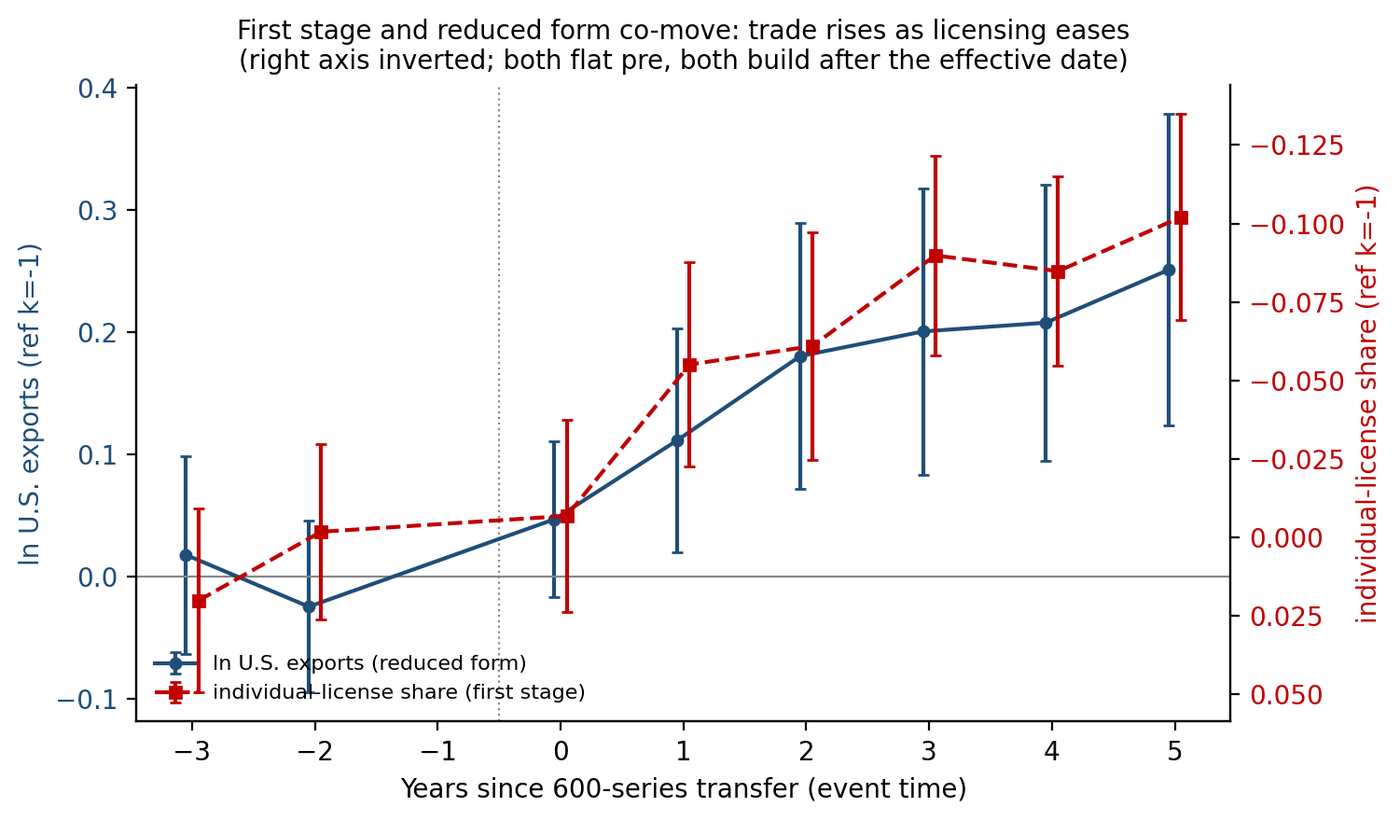
Between 2013 and 2017 the United States moved most items on its Munitions List from State Department licensing to new Commerce Department entries, the 600 series. Export filings record the license under which each shipment left: the share of the decontrolled products’ exports under individual State licenses fell from 26 percent to 13–16 percent, and their exports rose about 13 log points relative to comparable products, with an upper bound of 24. The gap does not follow the transfer dates or scale with licensing exposure, so the reform’s timing bounds its trade effect but does not identify it. The exposure gradients put the cost of individual licensing at about 5 percent of licensed trade, or roughly $0.5 billion a year. Shipments under the new entries to China totaled less than $3 million over 2013–2025.
-
Contract-Production Reliance and the Output Cost of Supply Disruption
Abstract
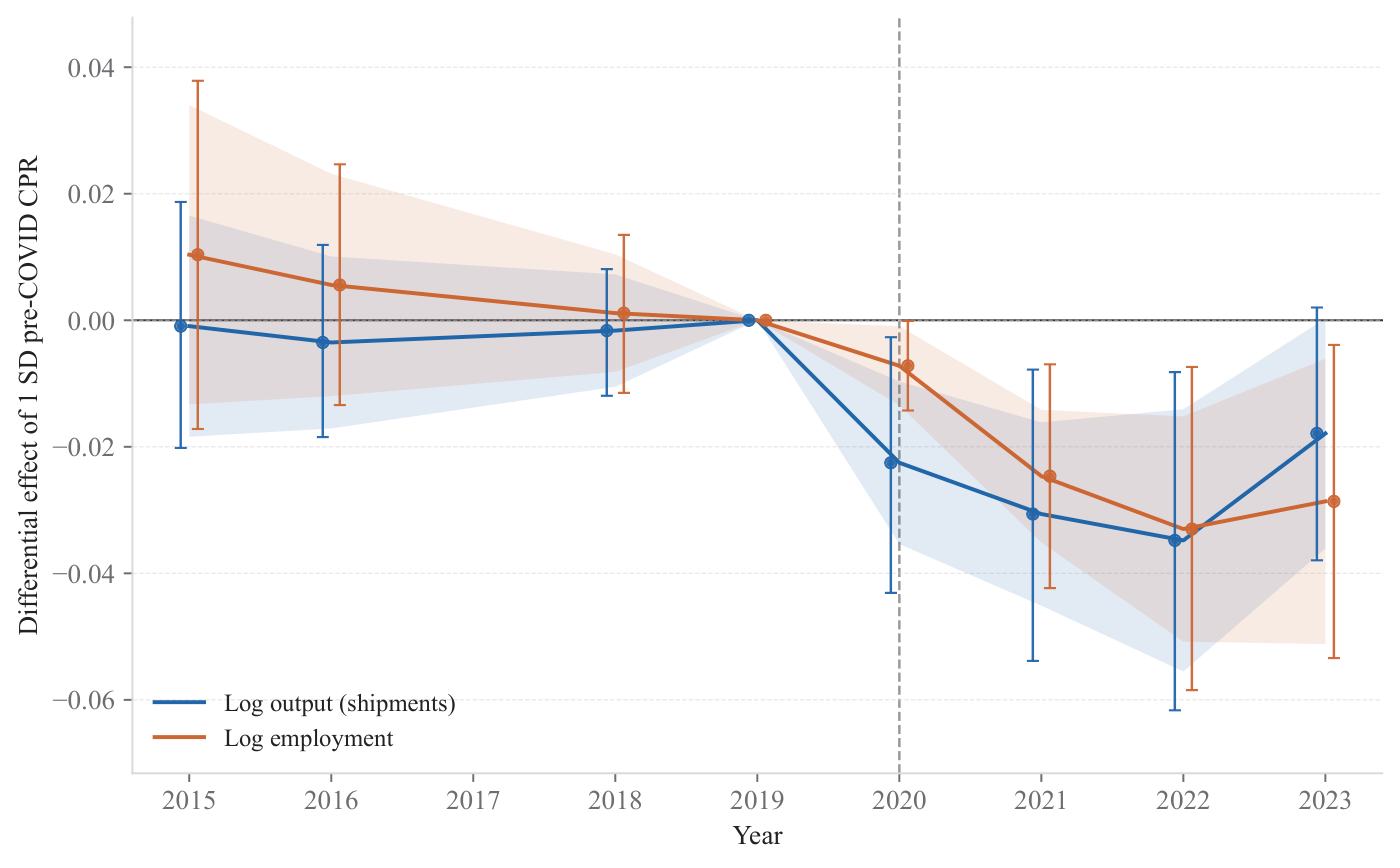
Contract-production reliance, what U.S. manufacturers pay outside contractors for work on materials they own, is nearly orthogonal to import penetration, so reshoring is poorly aimed at it. Industries one standard deviation more reliant lost about 2.4 percent more output over 2020–2023. The 2020 loss, 1.35 percent, survives controls for their customers' own shocks and for steel tariffs. Employment was still lower in 2024, and the most reliant industries cut contract work by nearly a quarter. European and Japanese panels show the same acute loss.
-
Elbows Up: Economic Coercion and U.S. Border Labor Markets in the 2025 Trade War
Abstract
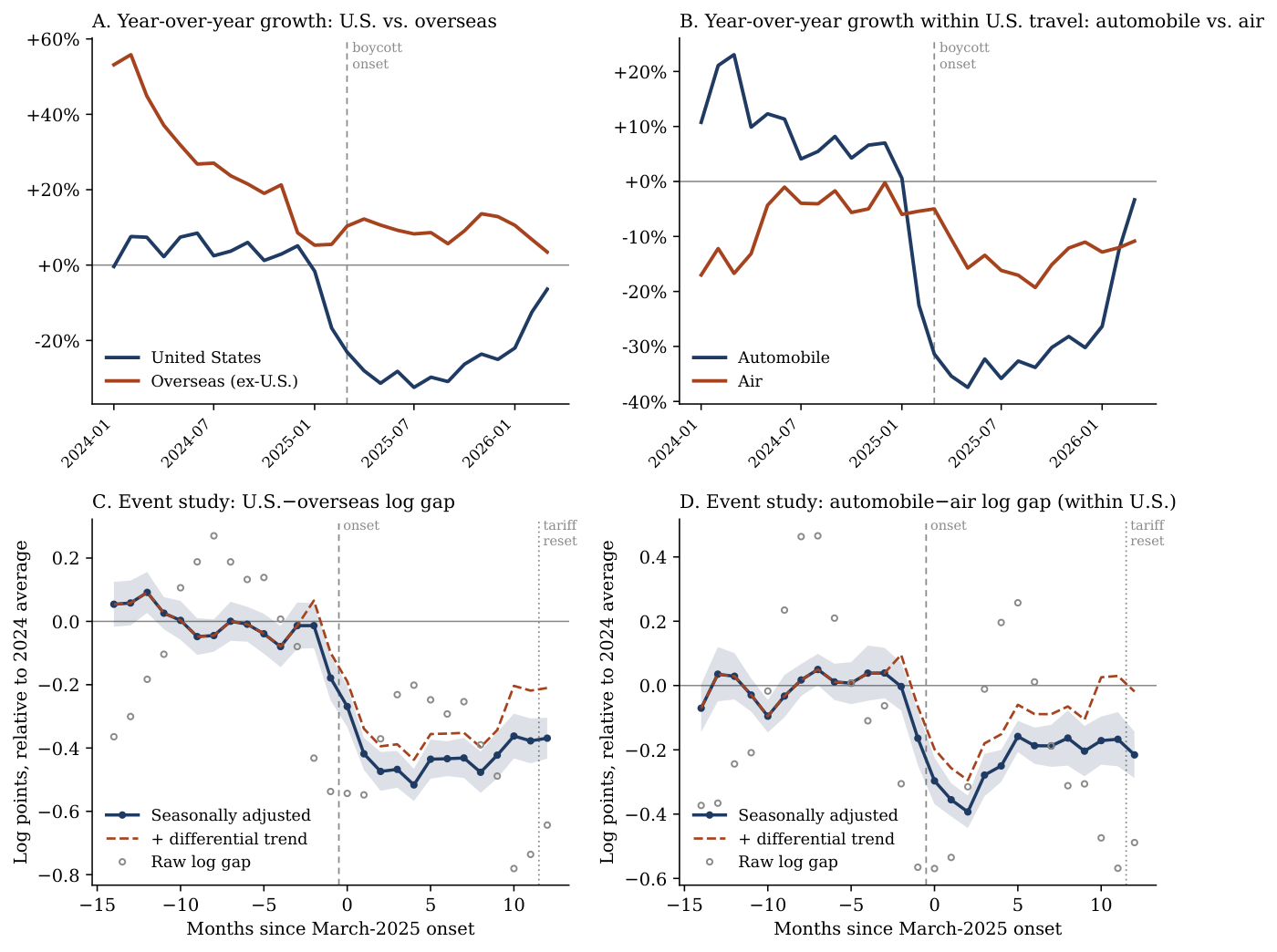
Beginning in early 2025, the United States paired tariffs on Canada with public statements questioning Canadian sovereignty, and Canadian consumers responded by boycotting travel to the United States. Across 352 U.S. metropolitan areas, leisure and hospitality employment fell with exposure to Canadian land traffic, while metros with comparable exposure to Canadian air visitors show no decline. Within metros, tourism-adjacent sectors fell about 0.3 percent per standard deviation relative to other sectors, a more conservative and less precise estimate. Scaled up, the gross local loss is roughly 6,000 to 35,000 jobs, concentrated in land-border communities, or 1.5 to 12 cents of earnings per dollar of tariff revenue collected on Canadian goods. Mexico faced the same tariffs without a boycott, and the southern border shows no gradient. The gradient did not narrow after the courts struck the tariffs down in February 2026.
-
Beyond Security: The Trade Implications of Joining NATO
Abstract
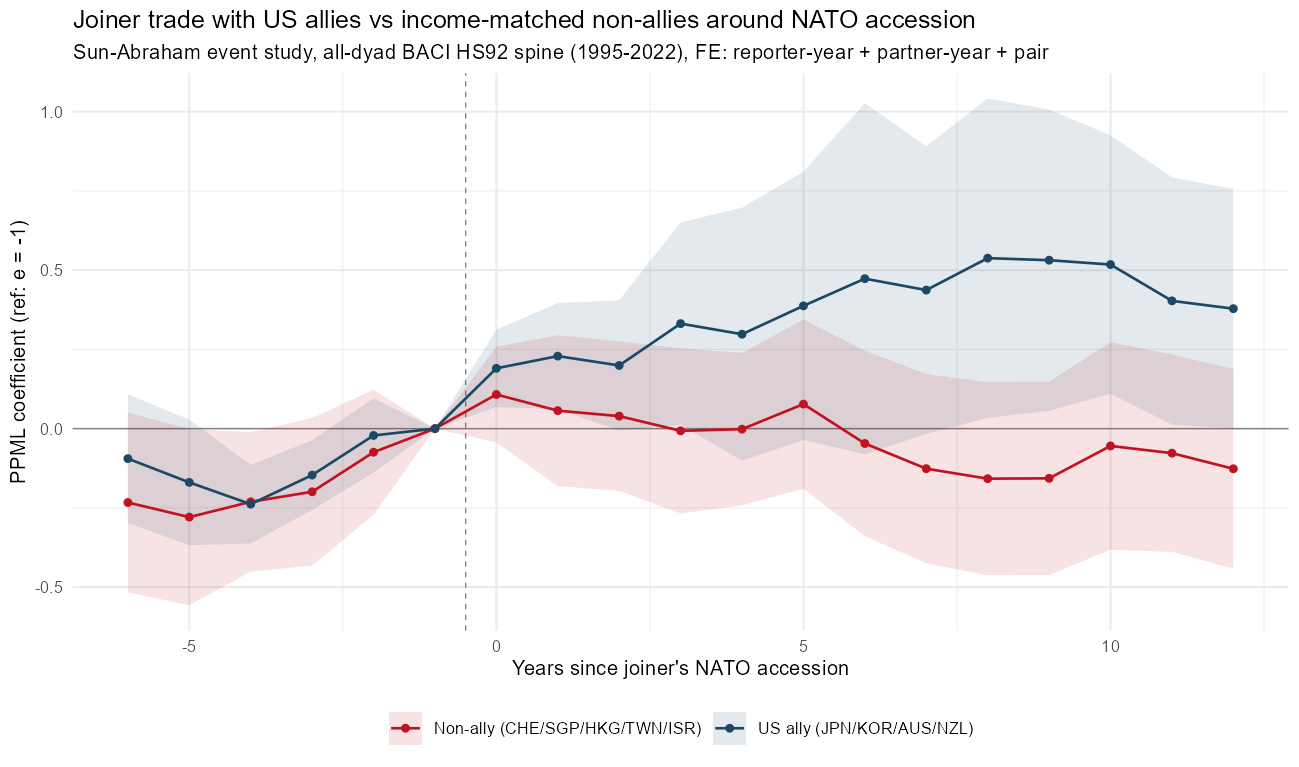
Article 2 of the North Atlantic Treaty commits members to economic collaboration but built no machinery for it, yet NATO accession is associated with higher trade among members on a scale that rivals deep trade agreements. On a bilateral panel covering 1948–2022 we ask what the premium is made of: it rises with product standardization and concentrates in standardized inputs; trade among members rose about 10 percent relative to outside pairs during Russia’s invasion of Ukraine; and accession reorients joiners’ trade toward non-member U.S. treaty allies.
-
Offshoring and the Decline in Labor-Market Dynamism
Abstract
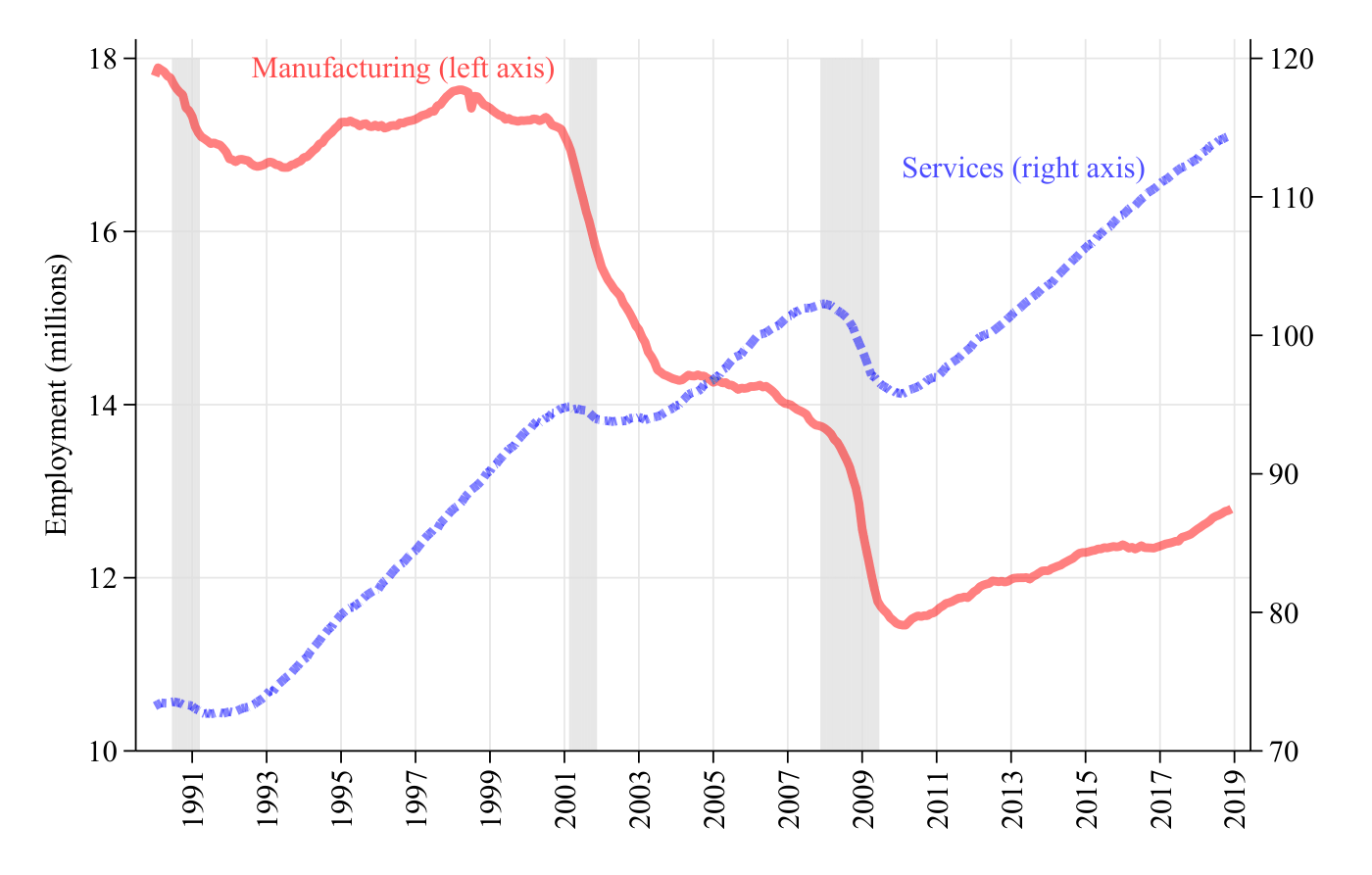
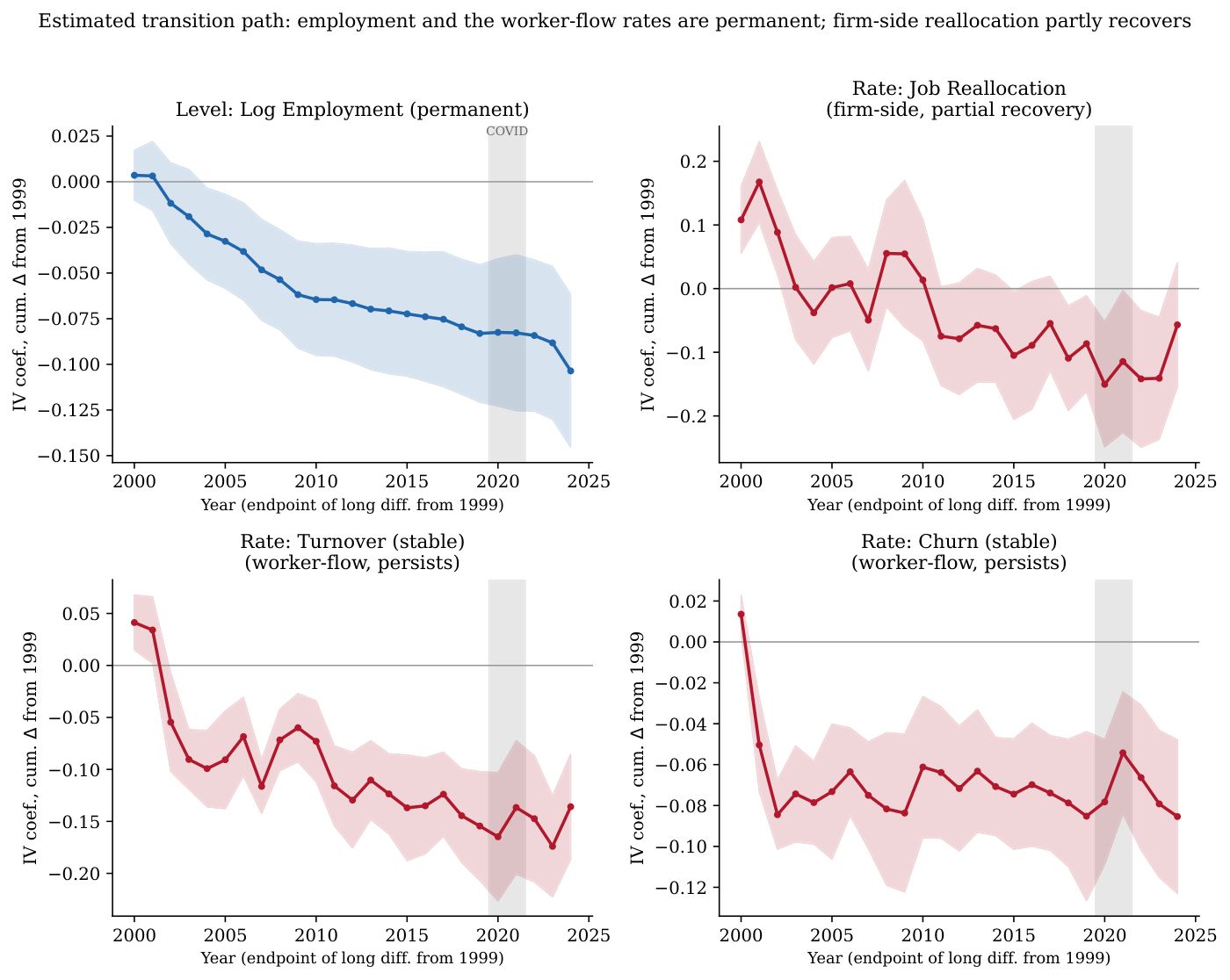
Instrumenting U.S. intermediate-goods offshoring with Chinese export-supply growth to other high-income countries, I find that offshoring permanently lowered labor-market dynamism, but from a narrow base. Offshored tasks were not replaced: manufacturing employment, turnover, and churn stay permanently lower, while the firm-side job-reallocation rate recovers by the mid-2010s. The base is narrow: 99 percent of the identifying variation sits in computers and electronics, and offshoring accounts for roughly one percent of the economy-wide fall in job reallocation.
Peer-reviewed
-
The Labor Market Effects of Immigration Enforcement
Abstract
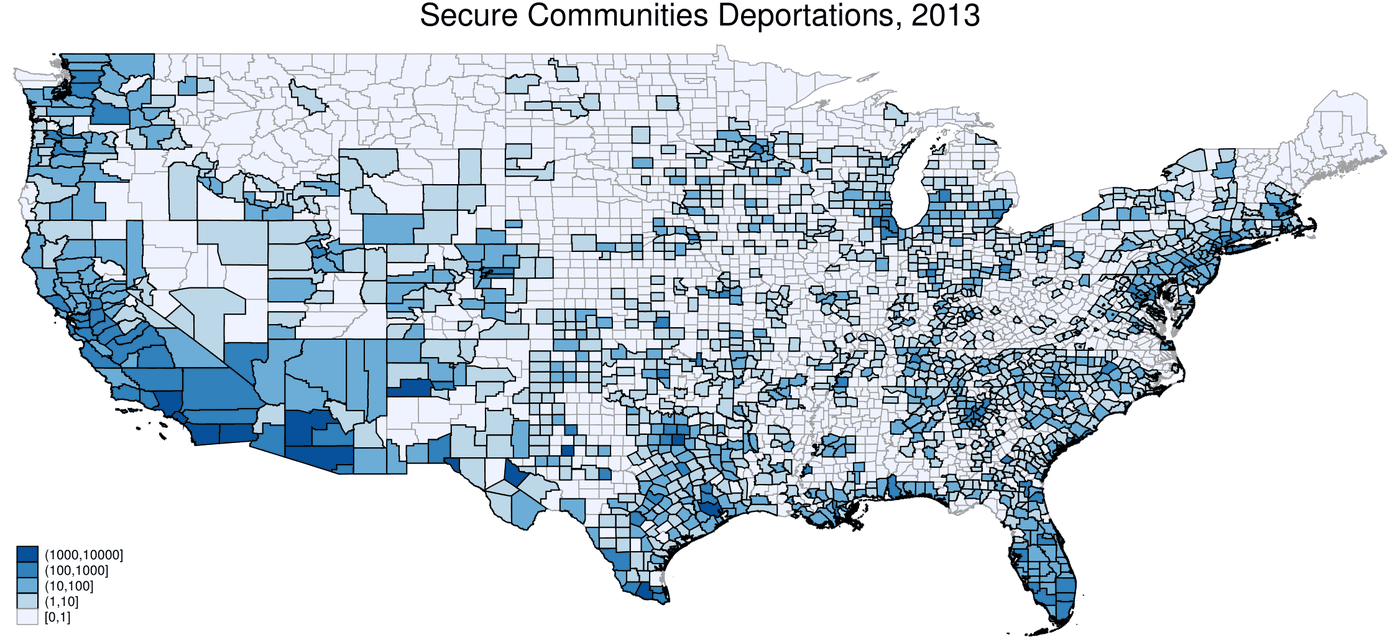
Secure Communities, a police-based interior enforcement program rolled out across counties in 2008–13, decreased the employment of likely undocumented immigrants, both through deportations and through the responses of those who remained. Enforcement also lowered the employment and hourly wages of U.S.-born workers, consistent with higher labor costs reducing job creation and with a decline in local consumption.
-
Intermediate Good Sourcing, Wages and Inequality: From Theory to Evidence
Abstract
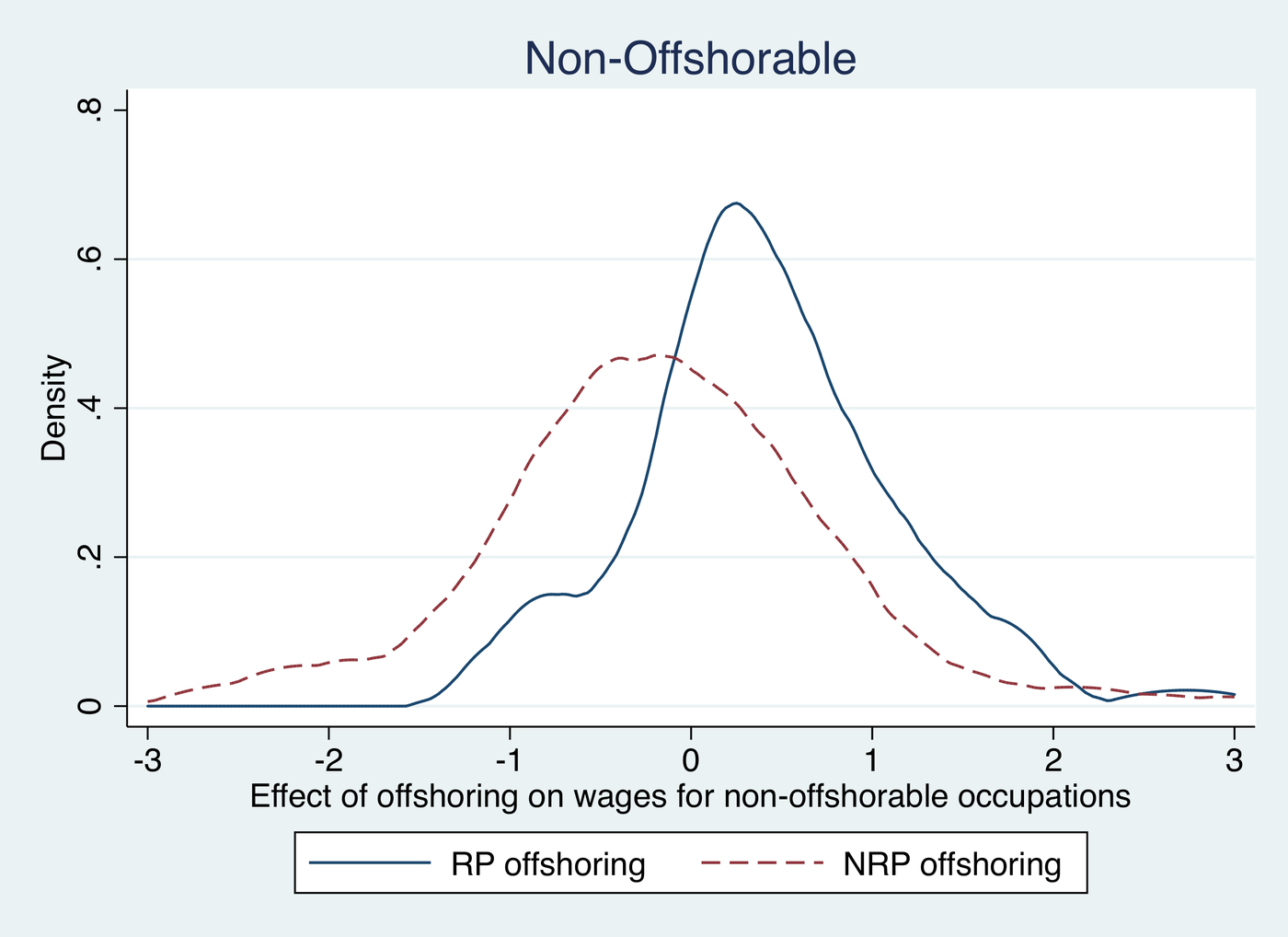
Labor market frictions shape where firms source intermediate production: matching costs govern whether production stays onshore, and the difficulty of assessing worker quality governs whether it stays inside the firm. The model predicts, and the data confirm, that the wage effects of offshoring depend on the type of offshoring (inter- versus intra-firm), the skill intensity of the industry, and the offshorability of the occupation.
-
Global Supply Chains, Firm Scope and Vertical Integration: Evidence from China
Abstract
Using disaggregated customs records on Chinese processing exports, I measure where cities sit on the value chain and ask how supply-chain position shapes firm boundaries. Ownership of intermediate suppliers responds to the position of inputs and the substitutability of sequential production stages, consistent with Antràs and Chor (2013), and value added rises as production moves toward final assembly.
-
In Search of the Armington Elasticity
Abstract
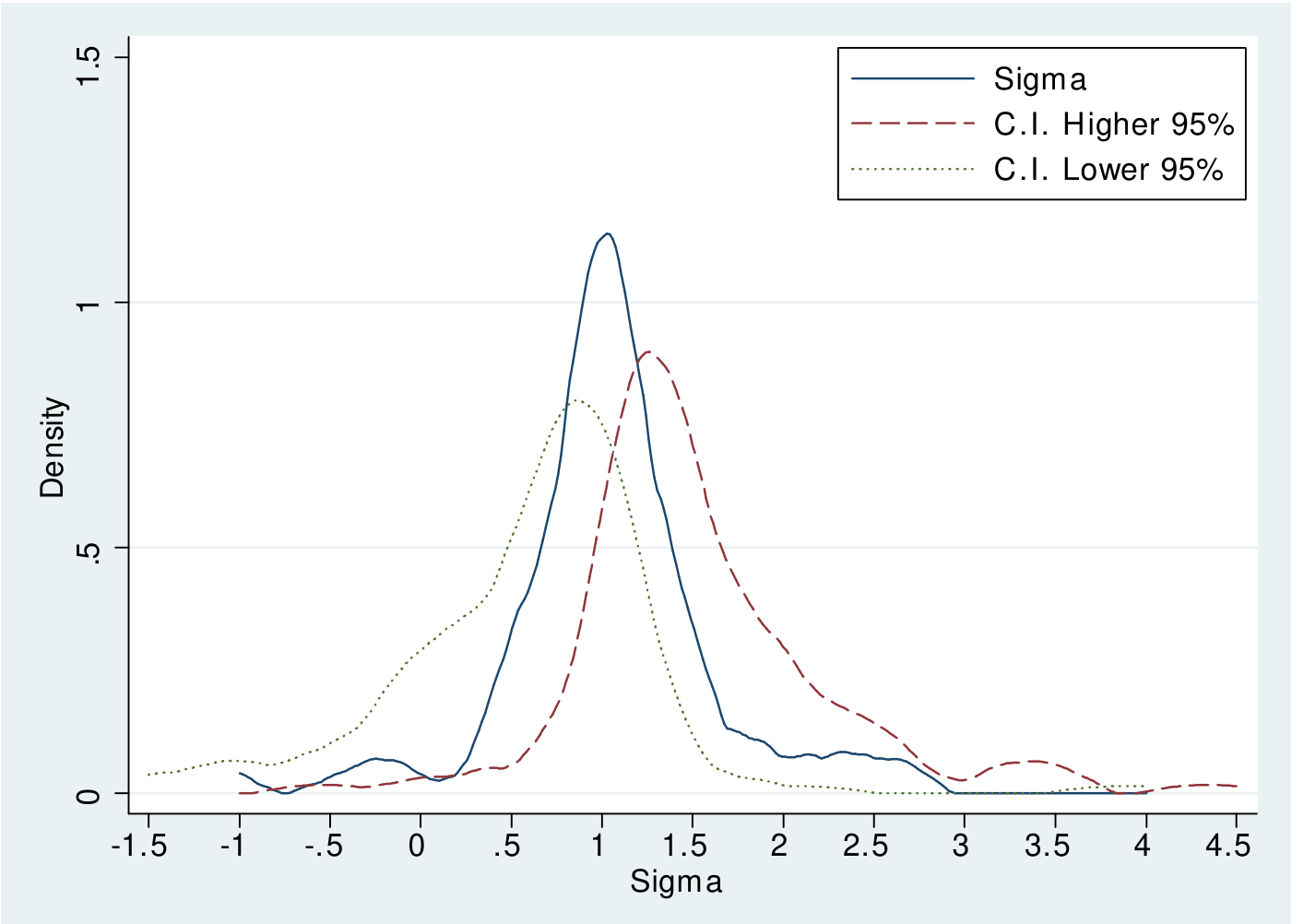
The elasticity of substitution between home and foreign goods anchors quantitative trade models, yet “macro” estimates between home and import goods routinely come in below the “micro” elasticity between foreign sources. Estimating both within a nested CES framework on U.S. production and trade data, we find no significant difference for about half of goods; for the rest the macro elasticity is genuinely lower, even at the same level of disaggregation.

In progress
- “Redefining Economic Security: Conceptual Boundaries, Analytical Frameworks, and Policy Implications.”
- “Impact of Tariffs on Technology Competition: Evidence from the U.S. Data Center Buildout.”
- “Economic Impacts of the Revocation of Temporary Protected Status.”
- “Entrepreneurship and Immigration Enforcement.”
- “Origins of Factoryless Goods Producers.”